

Selecting the correct surface finish for aluminium extrusion is not just about appearance. It directly affects durability, performance, and long-term maintenance.
Two common options used in international projects are anodized aluminium and powder coated aluminium. Each offers different advantages depending on application requirements.
This guide breaks down the differences in a straightforward way to help you make the right decision.
Anodized Aluminium: Durable and Consistent
Anodizing is a controlled electrochemical process that forms a protective oxide layer on the aluminium surface. Unlike coatings, this layer integrates with the base material.
The result is a uniform metallic finish that offers strong resistance to corrosion, wear, and environmental exposure.
Because there is no additional thickness, anodized aluminium maintains tight dimensional accuracy, making it suitable for precision applications.
Typical uses include:
- Window and door systems
- Curtain wall structures
- Industrial aluminium components
For export projects, anodizing thickness is usually specified at AA10–AA20 microns, depending on environmental conditions.
Powder Coated Aluminium: Flexible and Decorative
Powder coating applies a dry powder that is cured into a solid surface layer. This creates a protective and decorative finish on the aluminium.
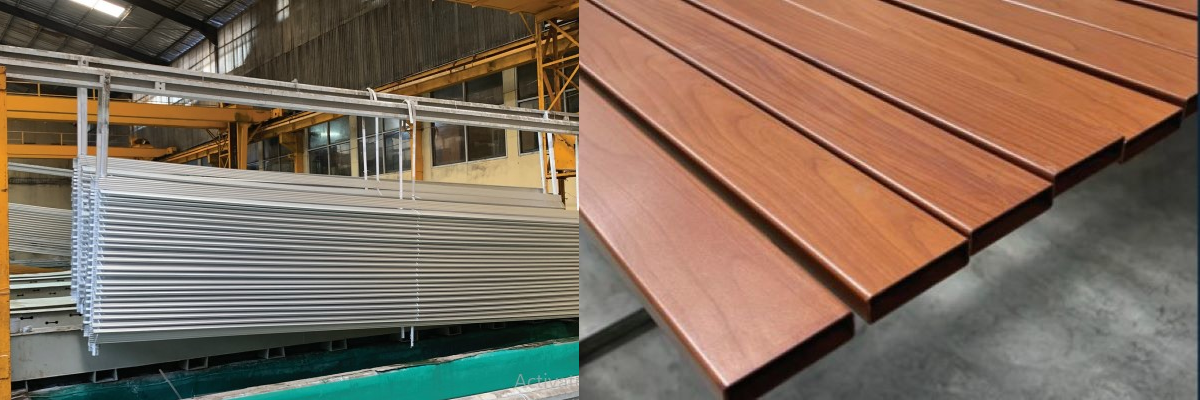
The main advantage is design flexibility. Powder coating supports a wide range of colors, textures, and effects, including wood grain finishes.
It is commonly used in applications where visual appearance is a priority, such as:
- Building facades
- Exterior architectural elements
- Design-focused structures
Main Differences to Consider
Surface Appearance
- Anodized → natural metallic, consistent finish
- Powder coated → wide color and texture options
Performance
- Anodized → strong long-term resistance to corrosion and wear
- Powder coated → good protection with proper pre-treatment
Thickness Impact
- Anodized → no dimensional change
- Powder coated → adds measurable coating thickness
Application Fit
- Anodized → engineering, structural, precision use
- Powder coated → architectural and decorative use
Is Anodizing Required Before Powder Coating?
No. Powder coating does not require anodizing.
Instead, aluminium undergoes chemical pre-treatment before coating to ensure proper adhesion and durability.
In specific environments such as coastal or high-corrosion areas, a combined system (anodizing + powder coating) may be used, but this is not standard due to higher cost.
Choosing the Right Finish
The correct choice depends on your project priorities.
Choose anodized aluminium when:
- Long-term durability is critical
- A metallic appearance is required
- Tight tolerances must be maintained
Choose powder coated aluminium when:
- Color and design flexibility are important
- A decorative finish is needed
- Surface customization is required
Manufacturing Control Matters
At ALCA, both anodizing and powder coating are handled within an integrated production system. This allows better control over surface quality, consistency, and finishing standards required for export markets.
Conclusion
Anodizing and powder coating serve different purposes. Neither is universally better — the right choice depends on how the aluminium profiles will be used.
Understanding these differences helps ensure better performance, consistent quality, and fewer issues after installation.
